Module 12: Demand, Capacity & Operational Flow
Learning Objectives
By the end of this module you should be able to:
- Understand the relationship between demand, capacity and flow.
- Recognise why increasing demand does not always require increasing capacity.
- Appreciate how bottlenecks affect the performance of the entire healthcare system.
- Understand why averages often fail to describe operational performance.
- Recognise how variation creates queues and delays.
- Ask better questions when interpreting operational data.
Why This Matters
Every healthcare organisation experiences pressure.
Emergency Departments become crowded.
Ambulances queue outside hospitals.
Elective waiting lists grow.
Patients experience delayed discharges.
It is tempting to assume these problems simply reflect insufficient capacity.
Sometimes they do.
But often they reflect something different:
How patients move through the healthcare system.
Healthcare behaves as a connected system.
Improving one part of the healthcare system does not necessarily improve the performance of the whole system.
Understanding demand, capacity and flow explains why.
Healthcare performance is rarely determined by demand, capacity or flow alone.
It emerges from the interaction between all three.
Understanding this interaction is fundamental to improving healthcare systems.
Demand, Capacity and Flow Are Interdependent
Healthcare systems perform well only when demand, capacity and flow are considered together.
Focusing on one element in isolation often moves pressure elsewhere rather than solving the underlying problem.
As shown in the figure below, each element continuously influences the others.
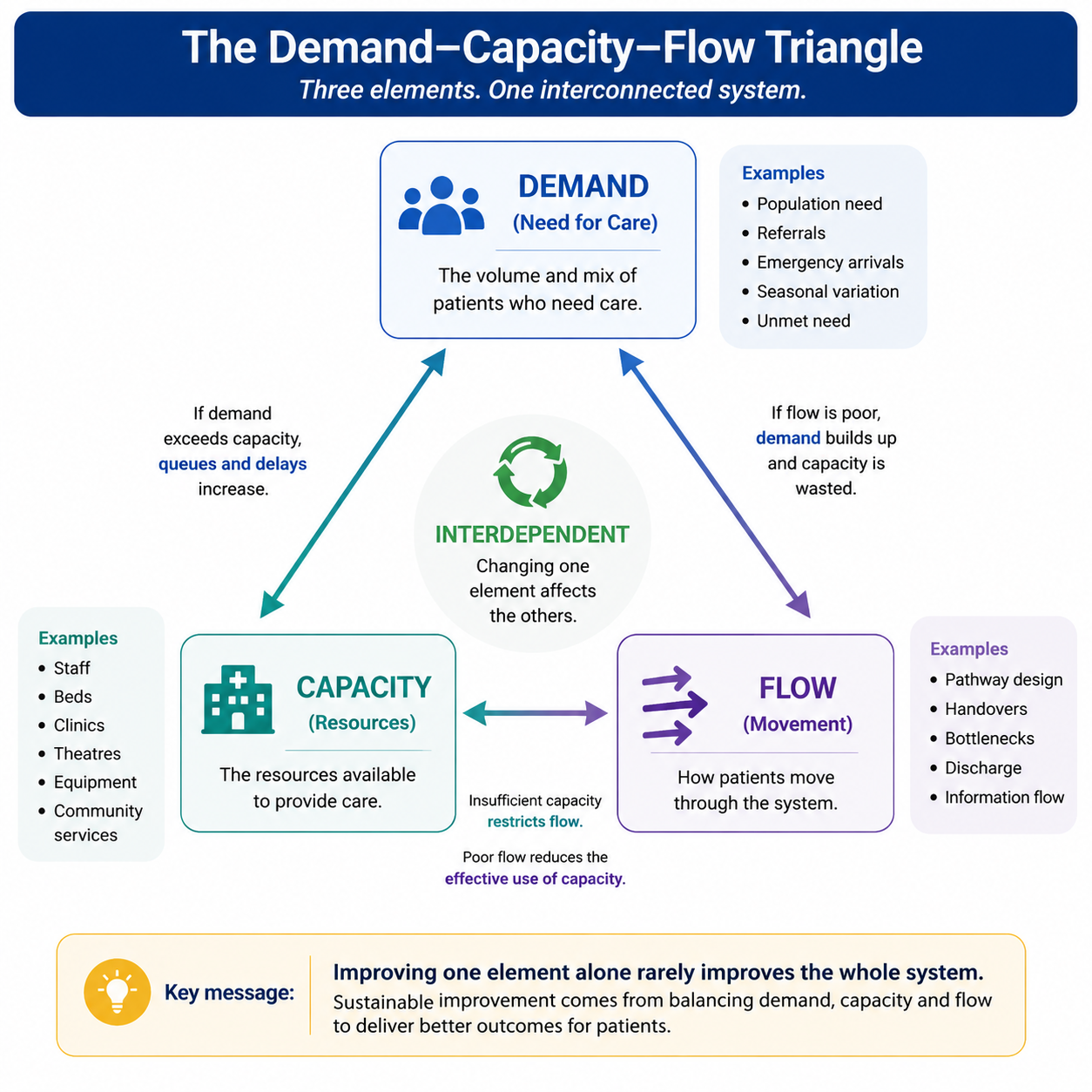
Demand, Capacity and Flow are interdependent. Sustainable improvement requires balancing all three components.
For example:
- increasing demand places greater pressure on available capacity
- poor flow reduces the effective use of existing capacity
- insufficient capacity creates delays that further reduce flow
Improving one component alone rarely produces sustainable improvement.
Demand Is Not The Same As Activity
Demand represents the need for healthcare.
Activity represents the care that is actually delivered.
These are not always the same.
For example:
- patients waiting for appointments still contribute to demand
- delayed patients continue to consume capacity
- unmet need may never appear in operational data
- cancelled appointments reduce activity but not demand
Understanding this distinction is essential.
Capacity Is More Than Beds and Staff
Capacity is often described simply as:
- staff
- beds
- clinics
- theatres
In reality, capacity also depends on:
- workforce availability
- diagnostics
- discharge processes
- community services
- social care
- digital infrastructure
A hospital with available beds but no discharge capacity is still constrained.
Similarly, additional staff cannot improve performance if another part of the system limits patient flow.
Flow Is Where Systems Succeed or Fail
Patients move through a sequence of healthcare services rather than a single department.
Delays in one part of the pathway rarely remain isolated.
As illustrated in the figure below, delays at a bottleneck propagate backwards through the system, creating queues upstream.
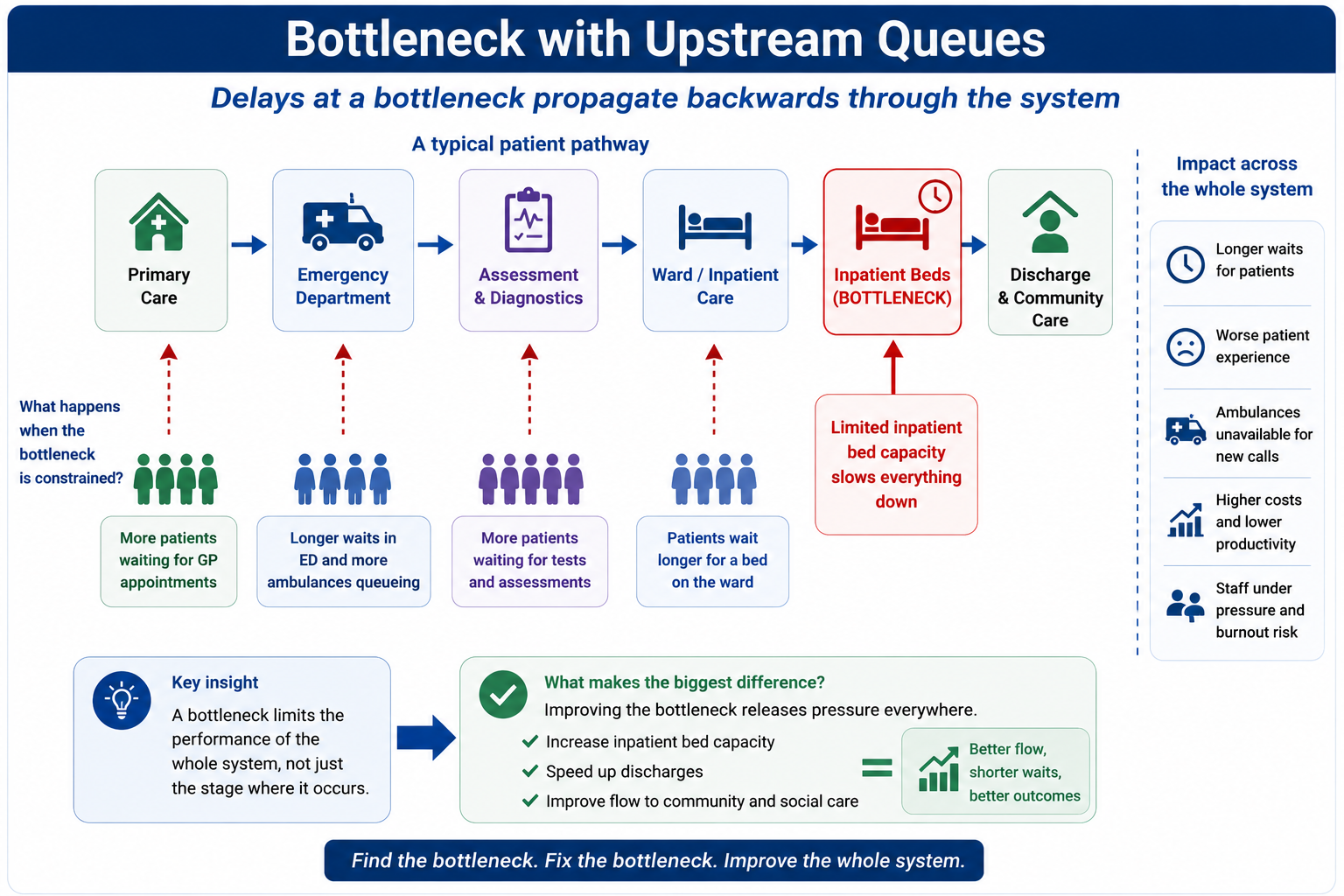
Removing the bottleneck improves performance across the whole pathway.
Every handover introduces the potential for delay.
Healthcare therefore behaves as a connected network rather than a collection of independent departments.
Bottlenecks
A bottleneck limits the performance of the entire system.
Imagine a motorway with four lanes narrowing to one.
Traffic builds long before the narrowing point.
Healthcare behaves similarly.
Common bottlenecks include:
- delayed diagnostics
- inpatient bed availability
- delayed discharge
- theatre capacity
- social care availability
Improving a non-bottleneck often has surprisingly little effect on overall performance.
Removing or reducing the bottleneck usually produces the greatest system-wide benefit.
Why Averages Can Mislead Operational Decisions
Suppose two Emergency Departments each receive:
300 attendances per day
The averages appear identical.
However:
- Hospital A receives patients steadily throughout the day.
- Hospital B receives large surges during the afternoon and evening.
As demonstrated in the figure below, both hospitals experience the same total demand, yet their operational experience is very different.
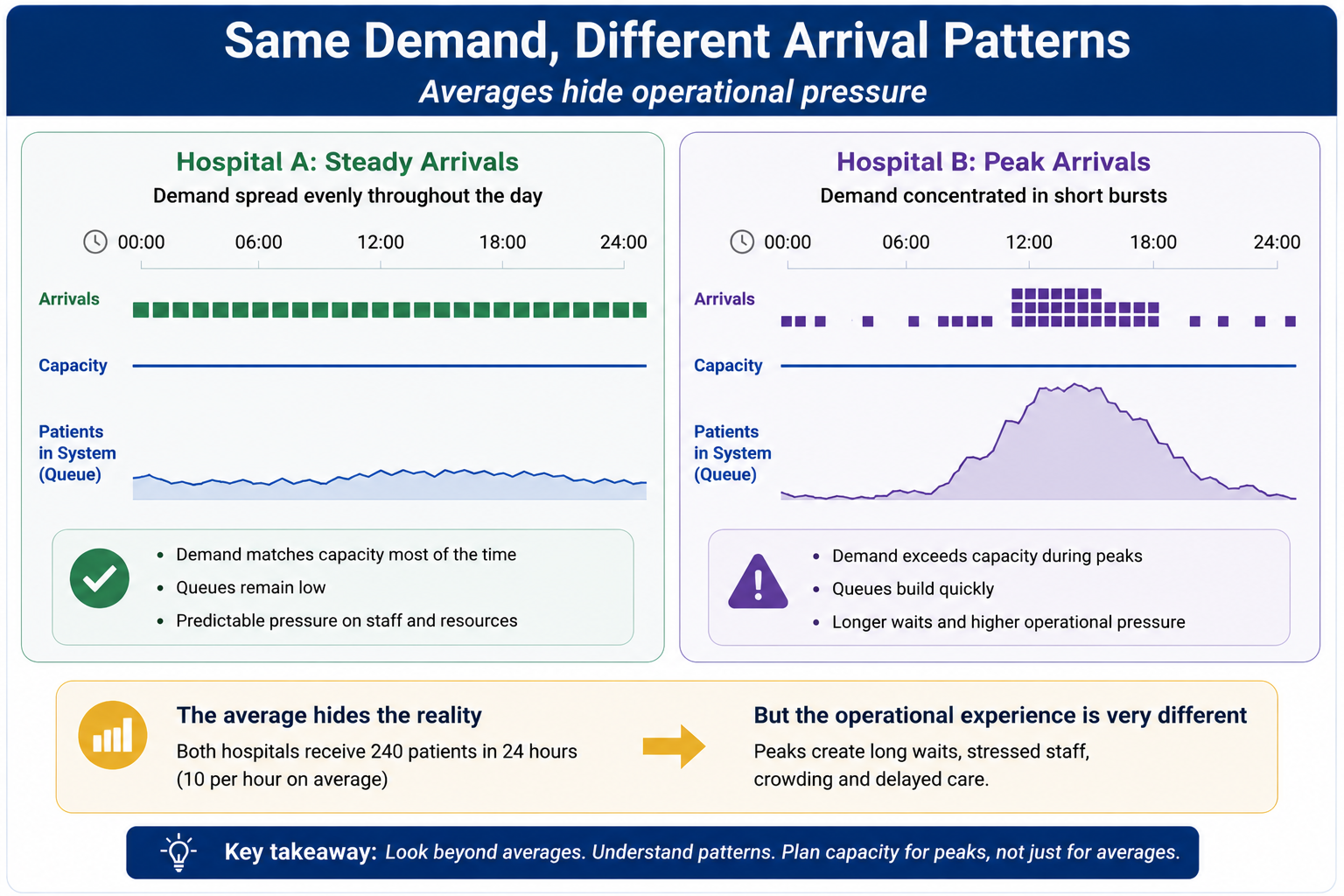
Two hospitals can experience very different operational pressures because of different arrival patterns.
Queues form because of variation, not simply because of average demand.
Operational pressure is often created by patterns of demand, rather than demand itself.
Variation Creates Queues
Healthcare demand is rarely constant.
Patients do not arrive evenly.
Similarly:
- staff sickness varies
- discharge timing varies
- theatre utilisation varies
- ambulance arrivals vary
- diagnostic turnaround times vary
Small variations accumulate throughout the system.
Queues are therefore a natural consequence of variation.
Reducing unnecessary variation often improves patient flow without increasing capacity.
High Utilisation Can Reduce Performance
Intuitively, high utilisation appears efficient.
However, systems operating continuously at maximum utilisation often become less resilient.
For example:
- fully occupied wards cannot absorb sudden admissions
- fully booked clinics have little flexibility
- operating theatres with no spare capacity struggle to recover from delays
Healthcare systems require spare capacity to cope with inevitable variation.
Maximising utilisation is therefore not always the same as maximising performance.
A Whole-System Perspective
Healthcare behaves as a connected system.
Changes in one part of the pathway frequently have consequences elsewhere.
As illustrated in the figure below, improving one part of the healthcare system does not necessarily improve the performance of the whole system.
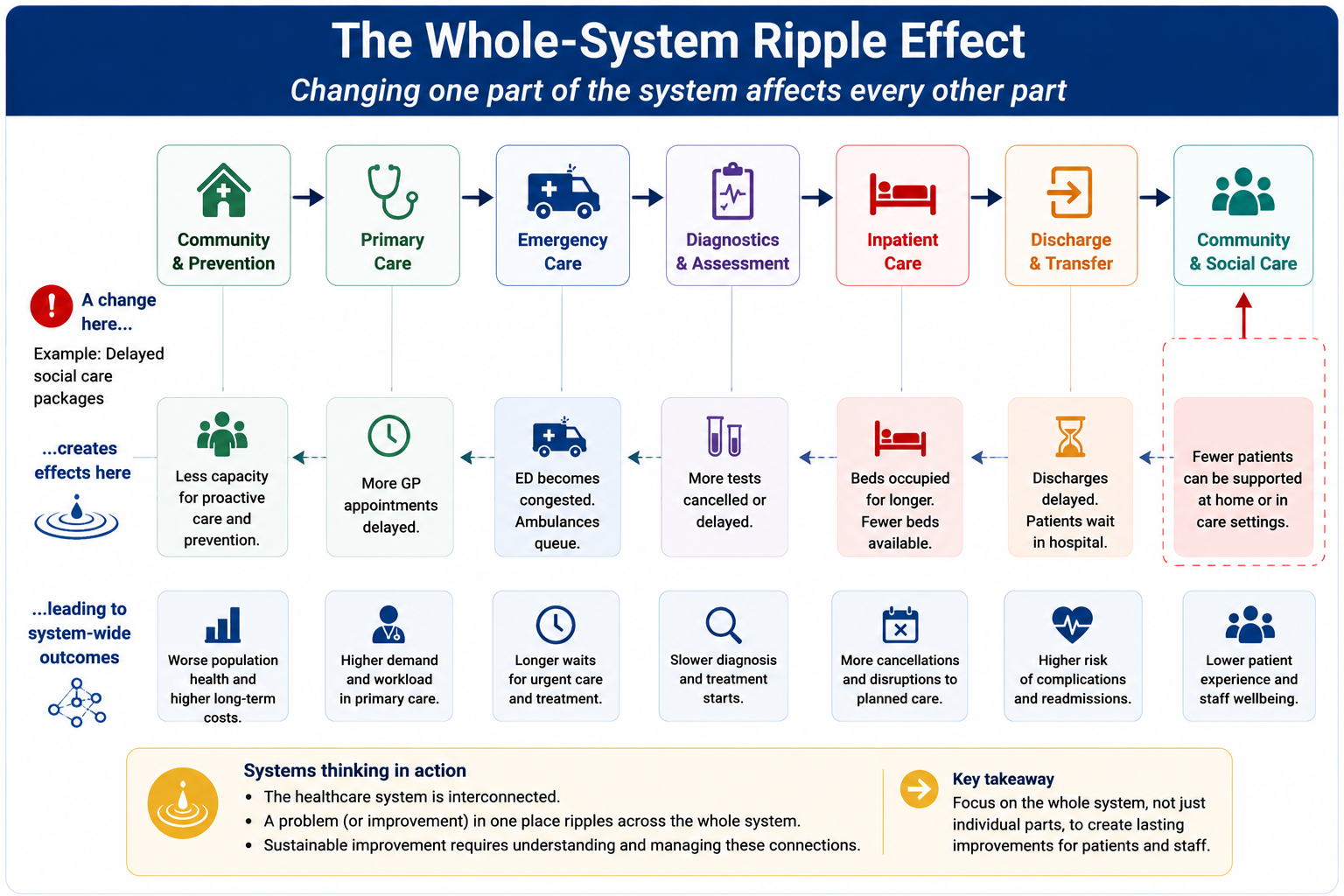
Healthcare behaves as a connected system. Changes in one part of the pathway create ripple effects across the wider healthcare system.
Problems originating outside hospital—such as reduced community capacity or delayed social care—can rapidly affect:
- Emergency Departments
- inpatient wards
- ambulance services
- elective care
Understanding these ripple effects is essential when designing improvement programmes.
Why This Matters for Decision-Makers
Many operational problems cannot be solved simply by increasing resources.
Sometimes organisations achieve greater improvement by:
- redesigning pathways
- removing bottlenecks
- reducing unnecessary variation
- improving discharge processes
- strengthening community services
- improving patient flow
The key question is often not:
“Where should we add more capacity?”
Instead it is:
“What is preventing patients flowing through the system?”
Improving one part of the system rarely improves the whole system.
Sustainable improvement comes from understanding how demand, capacity and patient flow interact across the entire healthcare system.
⭐ Worked Example: Why Can the Waiting List Grow While RTT Performance Improves?
Imagine an NHS organisation successfully increases the number of first outpatient appointments available in an effort to improve access to elective care.
More patients are seen sooner following referral, resulting in:
- more RTT clock starts
- more patients entering the elective treatment pathway
- improved access to specialist assessment
At first glance, this appears to be an unequivocal improvement.
However, if treatment capacity (for example, diagnostics, operating theatres or clinical workforce) does not increase at the same rate, more patients may enter the waiting list than leave it.
This creates an important system dynamic:
- RTT clock starts represent patients entering the waiting list.
- RTT clock finishes represent patients leaving the waiting list.
The size of the waiting list therefore depends on the balance between these two flows.
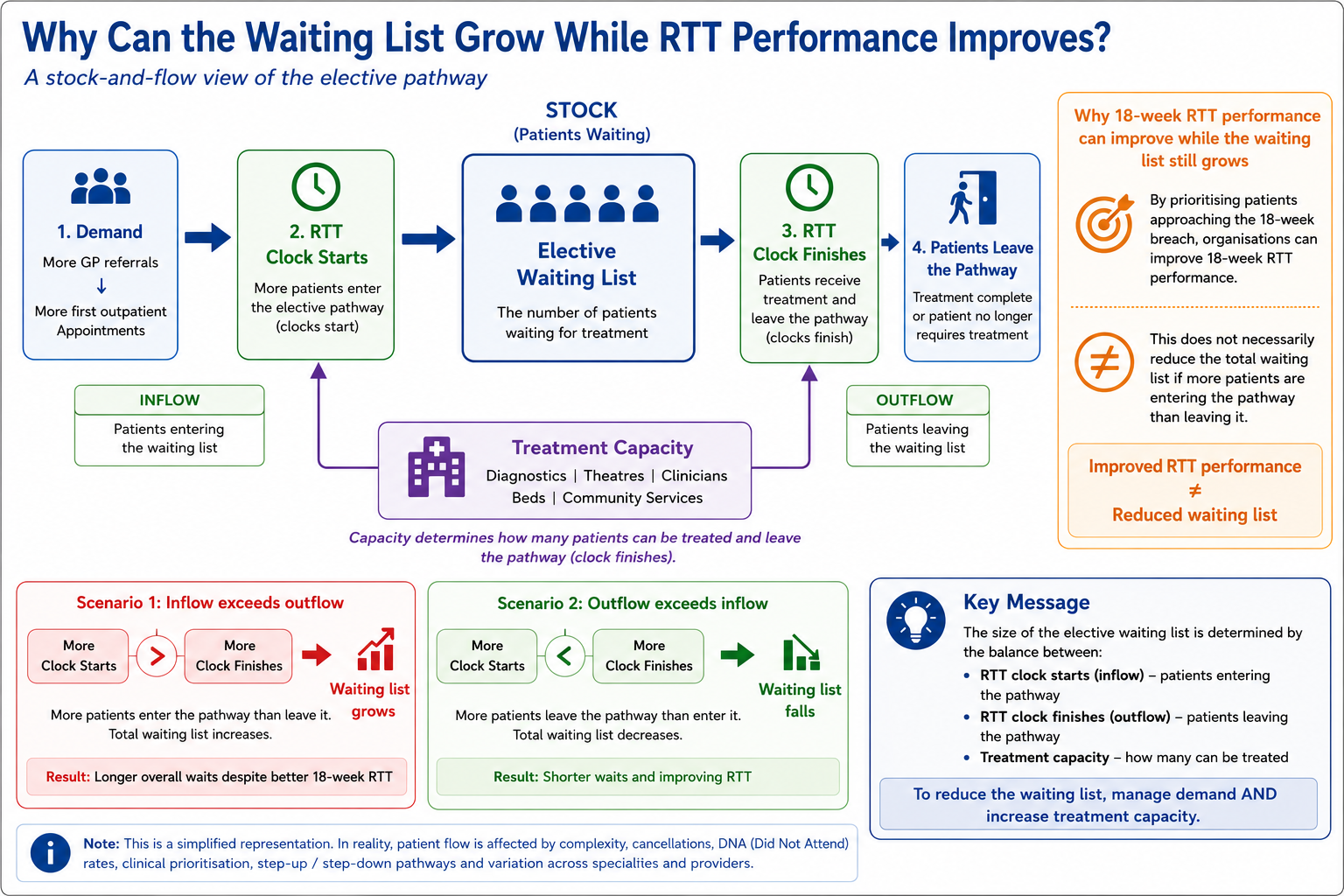
The waiting list behaves like a queue.
The waiting list is the stock, while RTT clock starts and RTT clock finishes are the flows into and out of that stock.
If RTT clock starts exceed RTT clock finishes, the waiting list grows.
If RTT clock finishes exceed RTT clock starts, the waiting list reduces.
The balance between these two flows determines whether the waiting list expands, contracts or remains stable.
One additional complexity is that organisations may improve their reported 18-week RTT performance by prioritising patients who are approaching the constitutional 18-week standard.
While this improves performance against the target, it does not necessarily reduce the overall waiting list if RTT clock starts continue to exceed RTT clock finishes.
Healthcare systems should be understood as interconnected stocks and flows, rather than as isolated performance measures.
Improving one performance metric does not necessarily mean the overall healthcare system has improved.
Understanding how patients enter, move through and leave the pathway is often more informative than looking at one performance indicator in isolation.
Questions Decision-Makers Should Ask
Before concluding that elective performance has improved, ask:
- Has referral demand increased?
- Have first outpatient appointments increased?
- Has treatment capacity increased by the same amount?
- Are RTT clock finishes keeping pace with RTT clock starts?
- Is the waiting list growing, shrinking or remaining stable?
- Are we improving patient flow through the whole pathway, or simply optimising one part of it?
- Which metric best reflects the performance of the whole pathway, rather than just one part of it?
Understanding the interaction between demand, capacity and patient flow provides a much richer picture of system performance than any single metric alone.
Looking at one performance measure in isolation may obscure important pressures elsewhere in the healthcare system.
The same principles apply across many areas of healthcare.
Whether considering Emergency Departments, diagnostics, community services, mental health, cancer pathways or elective care, healthcare systems are fundamentally influenced by the interaction between demand, capacity and patient flow.
Understanding how patients enter, move through and leave a pathway often provides far greater insight than focusing on individual performance measures in isolation.
This systems perspective is one of the foundations of effective healthcare improvement.
Key Takeaways
- Demand and activity are not the same.
- Capacity extends beyond beds and staffing.
- Flow determines how effectively healthcare systems operate.
- Bottlenecks affect the entire pathway.
- Variation creates queues.
- High utilisation is not always efficient.
- Improving non-bottlenecks often has limited impact.
- Whole-system thinking is usually more valuable than optimising individual departments.
Questions Decision-Makers Should Ask
- Are we measuring demand or activity?
- Is our constraint really capacity, or is it poor flow?
- Where are patients actually waiting?
- Which bottleneck is limiting overall system performance?
- Are averages hiding important patterns of demand?
- Could improving flow release more capacity than adding additional resources?
- How might changes in one part of the pathway affect another?
- Are we optimising individual services or improving the whole system?
- If this metric improves, what other parts of the system might be affected?
- What unintended consequences might this change create elsewhere in the system?
NHS Case Study: Delayed Discharge – A Whole-System Problem
Background
An acute hospital reports:
- Emergency Department waiting times are increasing.
- Ambulances are queuing outside the hospital.
- Bed occupancy is consistently above 98%.
- Elective operations are frequently cancelled.
The immediate assumption is:
The hospital needs more beds.
Initial Response
The organisation considers:
- opening additional inpatient beds
- increasing Emergency Department staffing
- recruiting more ward nurses
Each of these actions may provide short-term relief.
However, several months later, performance remains largely unchanged.
Looking Deeper
Further investigation reveals that many patients are medically fit for discharge, but cannot leave hospital because:
- community rehabilitation capacity is limited
- social care packages are unavailable
- community nursing services are under pressure
As a result:
- beds remain occupied unnecessarily
- new admissions cannot move from the Emergency Department onto wards
- Emergency Department cubicles remain full
- ambulances cannot offload patients promptly
The apparent hospital capacity problem is actually a patient flow problem.
Increasing inpatient beds without improving discharge processes may simply increase the number of occupied beds rather than improving patient flow.
Understanding the System
The visible pressure occurs in the Emergency Department.
The underlying constraint lies much further downstream.
Improving discharge capacity may release considerably more effective hospital capacity than simply opening additional inpatient beds.
This illustrates an important systems principle:
The constraint is not always where the pressure is most visible.
Applying Systems Thinking
Rather than asking:
“How do we create more beds?”
decision-makers might instead ask:
- What is preventing timely discharge?
- Which patients experience the longest delays?
- Which organisations influence discharge?
- Would investment in community services have a greater system-wide impact?
- Are we solving the bottleneck—or simply moving it elsewhere?
Lessons Learned
This example demonstrates that:
- operational pressure is often caused by poor patient flow rather than insufficient capacity
- bottlenecks create queues throughout the healthcare system
- increasing resources where pressure is most visible may not address the underlying constraint
- effective improvement requires understanding the entire patient pathway rather than individual services in isolation
The greatest pressure within a healthcare system is not always where the underlying problem originates.
As a leader, ask yourself:
If I remove pressure here, have I solved the underlying constraint—or simply moved the pressure elsewhere?
Looking at one performance measure in isolation may obscure important pressures elsewhere in the healthcare system.
Understanding how demand, capacity and patient flow interact is fundamental to improving healthcare systems.